Small enough for the chip. Benchmarked in public.
Research is the product. Two proprietary models from one training pipeline, built by the team that co-authored the speaker-recognition architectures the research community now measures itself against.
Two proprietary models, benchmarked
against leading commercial vendors.
Vosco Precise runs in the cloud and on-prem; Vosco Nano runs fully offline on-device. Both dominate the efficiency index — synthesis-detection accuracy per million parameters. Lower inference latency, lower cost, lower power consumption.
| Model | Efficiency index | Synthesis error % | Replay error % | Speaker accuracy % | Model size (M) |
|---|---|---|---|---|---|
| Vosco NanoOn-device · < 10 ms NPU · 100% offline | 1,400 | 4.6 | 4.5 | 98.4 | 7 |
| Vosco PreciseCloud & on-prem · < 10 ms GPU · 1,000+ streams | 194 | 3.1 | 2.0 | 99.3 | 50 |
| Modulate | 30 | 1.6 | — | — | 316 |
| Hiya | 10 | 2.3 | — | — | 1,000 |
| Resemble | 3 | 2.1 | — | — | 3,000 |
= (100 − Synthesis Error %) × (100 / Model Size in M)“—” means the vendor does not offer or report that signal. Comparisons are shown only where datasets, operating points and methodology are comparable; per-benchmark methodology notes accompany each published result.
Built on years of
speech AI research.
The trust check is only as good as the speaker model underneath it. Our team co-authored ReDimNet and ReDimNet2 — state-of-the-art speaker-recognition architectures.
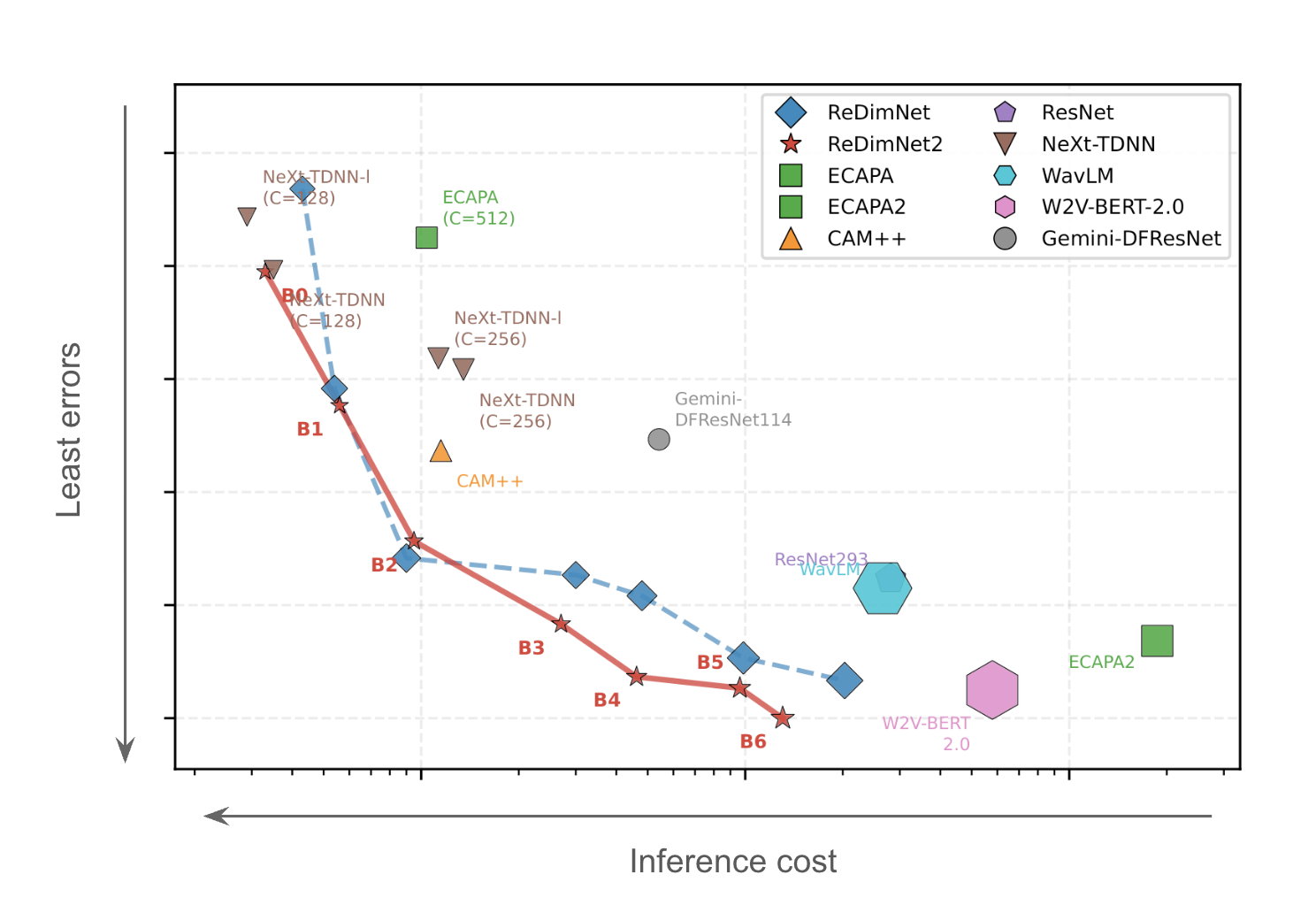
ReDimNet & ReDimNet2
Open-source speaker-recognition architectures, released under an MIT licence with code and pretrained weights. They lead public evaluations while staying among the smallest in parameters and FLOPs — which is what lets the same research run on a chip.
Test the models on your audio.
Run your own recordings through Vosco Precise and Vosco Nano, and compare the results at your operating point.